Selecting the appropriate radio frequency (RF) attenuator is crucial for ensuring the accuracy and reliability of measurements in RF testing applications. An incorrect choice can lead to significant financial losses and inaccurate results.
Understanding Attenuation and Its Applications
Attenuation is the process of deliberately reducing the power or amplitude of an input signal. In RF testing, this allows for modeling real-world operating conditions of devices in laboratory settings, ensuring measurement accuracy and repeatability.
Main Types of RF Attenuators
There are various types of attenuators, each with its own features and purposes:
-
Fixed Attenuators: Provide a constant level of attenuation and are used in applications where stable attenuation is required.
-
Variable Attenuators: Allow manual or software-controlled adjustment of attenuation levels, offering flexibility in setting test parameters.
-
Programmable Attenuators: Controlled via computer interfaces such as USB or Ethernet, enabling automation of the testing process.
Key Characteristics for Choosing an Attenuator
When selecting a microwave attenuator, consider the following parameters:
-
Attenuation Range: Defines the minimum and maximum attenuation levels the attenuator can provide.
-
Attenuation Accuracy: The deviation of the actual attenuation value from the specified one. High accuracy is critical for reliable measurements.
-
Impedance: The standard value for most RF applications is 50 ohms.
-
Insertion Loss: Signal losses that occur when connecting the attenuator to the test system. Minimal insertion loss ensures more accurate measurements.
-
Operating Frequency: The frequency range within which the attenuator can operate effectively. It's important that this range matches the frequencies used in your testing applications.
-
Attenuation Step Size: The minimum interval by which attenuation can be adjusted. Smaller steps allow for more precise settings.
-
Switching Speed: The time required to change the attenuation value. Fast switching is important in dynamic testing environments.
Fixed Attenuators: Overview of Models from COM-MW and Qualwave
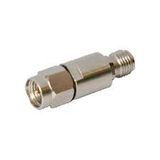
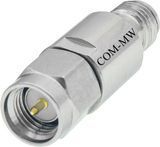
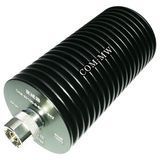
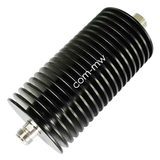
 Fixed attenuators are key components in signal transmission systems, providing a constant reduction in signal power by a specified amount. Let's look at two models from leading manufacturers: the new RF Attenuator DA9-30150-0-18000-1272 from COM-MW and the RF Attenuator QFA18K1-8-50-N2 from Qualwave.
-
RF Attenuator DA9-30150-0-18000-1272 – New from COM-MW
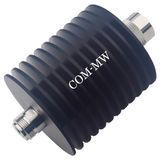
This attenuator operates in the frequency range from DC to 18 GHz, providing 30 dB signal attenuation. It is rated for up to 150 W power and has a 50-ohm impedance. The N-type connectors are made of stainless steel, and the housing is aluminum with a gray finish. The operating temperature range is from -40°C to +85°C. It's important to ensure adequate space around the attenuator for proper heat dissipation and to avoid placing it near equipment that generates significant heat.
-
RF Attenuator QFA18K1-8-50-N2 from Qualwave
This model operates in the frequency range from DC to 18 GHz and offers attenuation options from 3 dB to 60 dB. The impedance is 50 ohms, and the average power handling is up to 100 W at 25°C, with linear derating to 5 W at 120°C. The mechanical design ensures reliability and durability of the device.
Both fixed attenuator models are characterized by high-quality construction and reliability, making them ideal for use in various RF applications, including laboratory research, telecommunications systems, and radar complexes.
Modern Programmable Attenuators
In contemporary testing environments, digital programmable RF attenuators offer flexibility, convenience, and precision. They allow for simultaneous testing of multiple channels and easily integrate into test systems via standard interfaces such as USB. For example, some models come with software compatible with various operating systems, providing a simple graphical user interface and command-line control for managing attenuation.
Example of a Portable Programmable Attenuator from Adaura Technologies

The American manufacturer AdauraTech offers a series of programmable RF attenuators, including the AD-USB R4 model. This device features:
-
Attenuation Range: Up to 120 dB, providing a wide range of settings for various test scenarios.
-
Control Interfaces: USB and Ethernet, allowing easy integration into modern test systems and control via web interface or Telnet.
-
Compact Design: The aluminum housing ensures durability and ease of use.
These features make the AD-USB R4 a versatile solution for laboratories and production environments where high precision and flexibility in setting attenuation parameters are required.
Rackmount Programmable Attenuators
Rackmount programmable attenuators provide precise and flexible signal level control in various high-frequency systems. They are widely used in laboratory research, production testing, and wireless device development, where modeling different signal transmission conditions is necessary.
One of the leading manufacturers of such solutions is Adaura Technologies, which offers a series of rackmount programmable attenuators with various configurations. These devices support a frequency range from 100 MHz to 8 GHz and provide an attenuation range up to 120 dB with a step size of 0.05 dB. The number of channels varies from 10 to 64, depending on the model and chassis size (from 1U to 5U). For convenient integration into modern test environments, the attenuators are equipped with USB and Ethernet interfaces, allowing control via web interface or Telnet.
Rackmount programmable attenuators are indispensable tools for engineers and researchers working on the development and testing of high-frequency devices and systems. They provide high precision, reliability, and ease of use, contributing to increased efficiency and quality in research and testing.

Variable Attenuators: Example of Rotary Step Attenuators from Qualwave
Variable attenuators allow for adjustment of signal attenuation levels according to the specific requirements of an application. One type of such devices is rotary step attenuators, which provide precise and reliable attenuation settings through mechanical rotation of the control element.