
Power Meters & Power Sensors
Power is a fundamental parameter that characterises the properties of microwave signals, and its precise measurement is a critical aspect of modern microwave measurements. The microwave power meter is the foundational measurement device among instruments measuring microwave power characteristics.
Ceyear Technology has a long standing commitment to researching microwave power measurement technology a nd developing related products. Our product portfolio includes microwave power meters, USB power sensors , LAN power sensors and more. Operating across the DC to 110 GHz frequency range, we deliver flexible, scientifically rigorous measurement solutions that are tailored to the specific testing requirements of power measurement applications.
Microwave power meters enable the accurate measurement of various parameters, including average power, peak power, peak to average power ratio (PAPR), pulse width, rise time and pulse period. Key specifications include a single probe maximum average power dynamic range of 96 dB, a maximum peak power dynamic range of 55 dB, broa dband coaxial frequency coverage of up to 110 GHz, a rise time of ≤13 ns and a minimum measurable pulse width of 50 ns.
Ceyear Technology utilises the 2439D microwave power meter as the base platform, paired with USB power sensors from the 87233, 87235, 87 236 and 87237 series, for performing average and peak power measurements. These USB power sensors can also connect to computers, laptops, or other Ceyea measurement instruments.
87245 and 87246 Series LAN power sensors connect to computers via PoE switches , enabling power monitoring up to 60 metres away. This makes them ideal for scenarios requiring long distance power measurement transmission, such as production line testing, field testing, and remote monitoring.

Product Overview
When paired with different types of USB power sensors, the 2439D Microwave Power Meter enables accurate measurement of average and peak power. It supports the simultaneous connection of up to four power sensors for efficient, multi channel measurements. Power measurements can be performed rapidly via the front panel function keys or touchscreen, with results displayed as numerical values or waveforms.
The table below lists the USB Power Sensor types that are com patible with the 2439D Microwave Power Meter, along with their respective measurement modes. Select the appropriate USB Power Sensor based on your requirements.
Key Features
- Compact size, lightweight, and battery powered for use
- Connects up to 4 Power Sensors simultaneously for multi channel power testing
- Combines buttons and touchscreen for intuitive operation
- Rapid waveform stabilization via “Auto Setup” function
- Features GPIB, Ethernet, and USB interfaces for remote control ope rations
| Model | Description | Functions | Measurement Mode | ||||
| CW Average |
Modulation Average |
Trace | Time Gate |
Statistics | |||
| 87233 | USB CW Power Sensor |
Fast and Accurate Measurement of CW Signals |
● | — | — | — | — |
| 87235 | USB Average Power Sensor |
CW and M odulated signal rapid and accurate measurement |
● | ● | — | — | — |
| 87236 | USB Peak/Average Power Sensor |
Pulse modulation signal time and power parameter measurement and analysis |
● | ● | ● | ● | ● |
| 87237 | USB Thermocouple Power Sensor |
Precise power measurement in the power reference and calibration laboratory |
● | ● | — | — | — |
Compatible with multiple high accuracy power sensors
The 2439D microwave power meter supports plug and measure compatibility with the following Power Sensor series:
- 87233 USB CW Power Sensors
- 87235 USB Average Power Sensors
- 87236 USB Peak/Average Power Sensors
- 87237 USB Thermocouple Power Sensors
Each power sensor is factory compensated, with all compensation data stored internally. This eliminates the need for calibration before measurement and ensures long term stability.
Rich Interfaces

The front panel of the 2439D features two channel interfaces, labelled A and B. A and B. The USB port in the bottom right hand corner can be shared with the C channel on the rear panel. However, only one probe can be connected to both the lower right USB port and the rear panel C channel simultaneously.
The rear panel of the 2439D has two channel interfaces: C and D, and the USB port can be shared with the D channel. On ly one probe can be connected to both the USB port and the D channel simultaneously.
Multiple measurement modes
The 2439D microwave power meter supports multiple measurement modes:
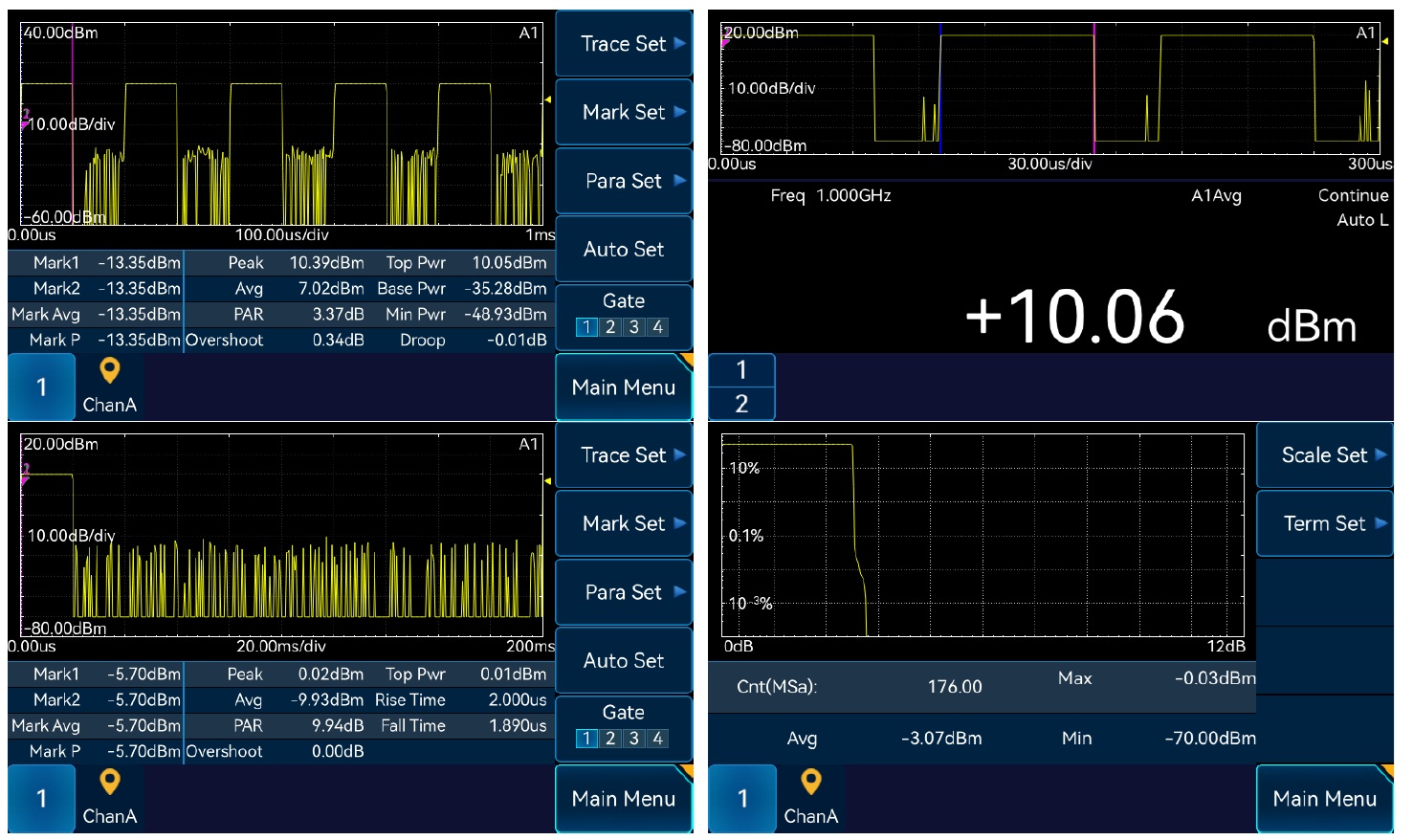
Averaging mode: This mode enables precise average power measurements for continuous wave signals and various modulated signals, including common wireless signals such as 5G, LTE, Wi Fi and WLAN.
Trace mode: Displays envelope power over time, presenting results as a combi nation of waveforms and numerical values. It supports the simultaneous measurement of up to 16 pulse parameters, with a maximum of eight parameters displayed concurrently on the panel.
Time Gated Mode: This mode measures average power, peak power, peak to average ratio and minimum power within up to four independent time gates. The start position and duration of each gate can be defined, and measurements from two gates can be combined.
Burst Power Mode: This mode enables the rapid capture and measurement of large cycle burst power by configuring a normal trigger mode.
Statistical Mode: The CCDF statistical measurement mode calculates the percentage of power that exceeds or is equal to a specified threshold.
External Trigger Functions
By connecting an external trigger signal via a trigger cable, stable triggering of low power signals can be achieved and timing measurements can be initiated based on the external trigger signal.
Wider Operating Temperature Range
The 2439D microwave power meter and series USB Power Sensor s have a wider operating temperature range of -10°C to 50°C. They maintain the same power measurement accuracy at temperature extremes as in ambient conditions.
2U Standard Rack Mounts Kit
An optional 2U standard rack mount kit is available for the 2439D, facilitating integration into cabinets for building test systems.
Battery Option
The 2439D microwave power meter delivers at least 5 hours of continuous operation when fully charged and connected to two Power Sensors , making it ideal for field testing.
Extensive Programmable Interfaces
Standard LAN, USB and GPIB interfaces are included. The LAN interface fully supports Socket, VXI 11 and HISLIP protocols, as well as network auto discovery, enabling simple and efficient instrument networking.

87233 USB CW Power Sensor (8 kHz to 67 GHz)
The 87233 Series USB CW Power Sensor is a high precision instrument for measuring continuous wave signal power over a wide dynamic range. It is based on a USB 2.0 interface, enabling accurate measurements. It is primarily intended for use in field and prod uction line testing and system integration.

Key Features
- Wide frequency range and Large measurement dynamic range
- Covers frequencies from 8 kHz to 67 GHz and has a power measurement range of -70 dBm to +20 dBm. It provides high power measurement accuracy of 0.20 dB for the 87233C within the -40 dBm to +20 dBm range
- Compact, Portable design for handheld operation
- Less than 0.3 kg weight for easy carrying
87235 USB Average Power Sensor (8 kHz to 67 GHz)
The 87235 Series USB Average Power Sensor is a high precision, wide dynamic range average power measurement instrument based on the USB 2.0 interface, enabling accurate measurement of the average power of modulated signals.

Key Features
- Wide frequency range and Large measurement dynamic range
- It features wide frequency coverage and a large dynamic range spanning 8 kHz to 67 GHz, and power measurements ranging from -70 dBm to +44 dBm
- Accurate measurement of multiple type signals
- It enables the accurate measurement of the average power of modulated signals, making it ideal for power measurements in communications and other fields. Supported signal formats include continuous wave, pulse modulation and vector modulation, including 3G, 4 G and 5G
- Outstanding average power measurement accuracy
- It delivers outstanding average power measurement accuracy. For instance, the 87235C achieves power measurement accuracy of 0.20 dB within the range of -40 dBm to +20 dBm
87236 USB Peak/Average Power Sensor (50 MHz to 67 GHz)
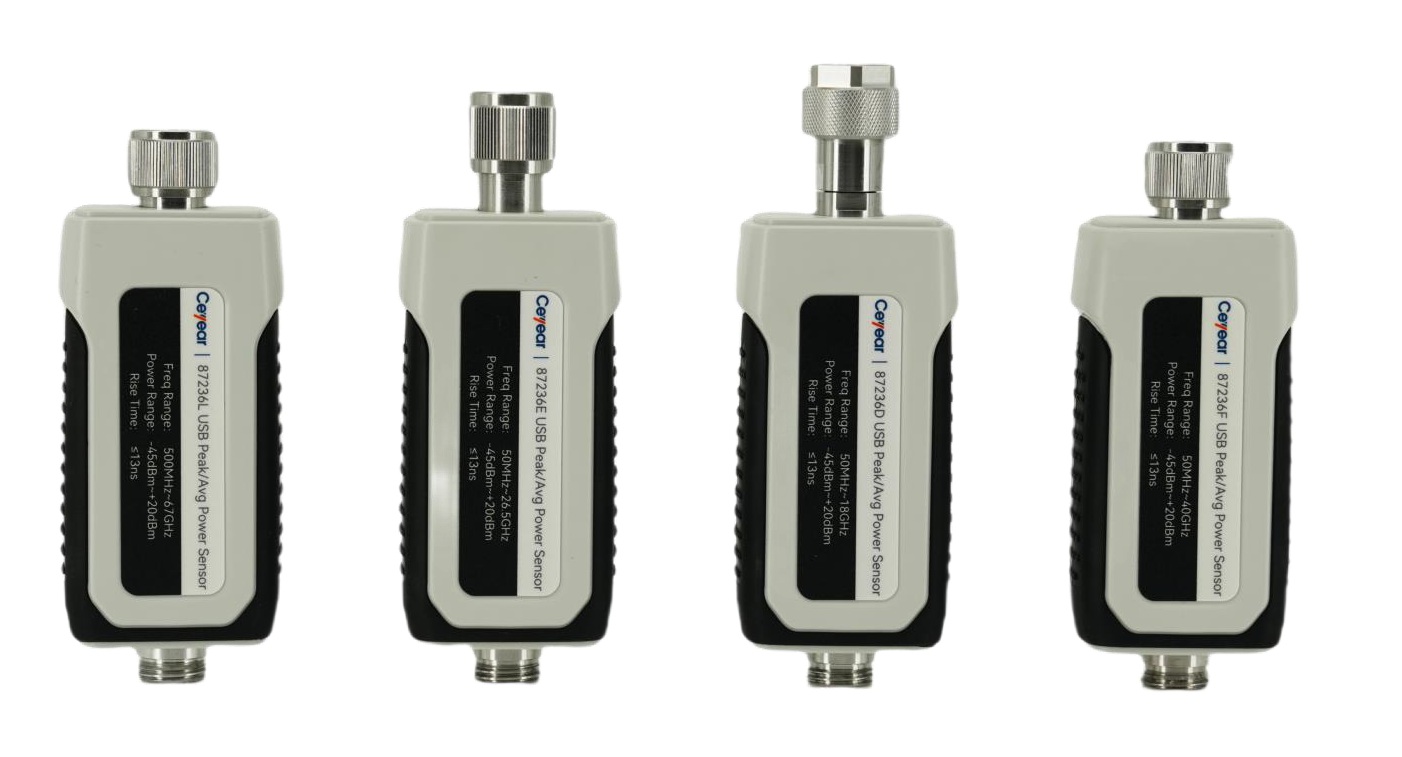
The 87236 Series USB Peak/Average Power Sensor is a broadband power measurement instrument that uses a USB 2.0 interface to enable average and pulse power measurements, as well as CCDF statistical analysis. It has a frequency range of 50 MHz to 67 GHz, with maximum average power measurement accuracy o f 0.20 dB, a video bandwidth of ≥30 MHz and rise/fall times of ≤13 ns. This compact and lightweight product utilises USB power and communication for connection to a computer. It can be used to expand the power measurement capabilities of electronic measur ement instruments and test systems, making it suitable for field testing, production line testing, and system integration.
Key Features
- The 87236 Series features average power measurements down to 45dBm and pulse envelope measurements down to 35dBm, with average power measurement accuracy up to 0.20dB. It supports external triggering in average only mode. By adjusting aperture size and trigger delay, users can select any portion of the waveform for measurement
- The 87236 Series accurately measures both power and timing parameters of pulsed signals. With a maximum video bandwidth of 30 MHz and rise/fall times of 13 ns, it can measure puls es with widths down to 50 ns
- The 87236 Series enables internal zero calibration of Power Sensors via internal switching circuits when connected to the device under test. This accelerates measurement speed, reduces connector wear, and lowers measurement un certainty
- The 87236 series incorporates a built in trigger input function. Using the standard trigger cable, external trigger signals from the signal source or device under test can be connected to the Power Sensor, enabling precise triggering of small si gnals approaching the lower limit of signal noise
- The auto measurement function allows users to obtain measurement results with a single button press when measuring pulse modulated signals
- Auto measurement covers 16 pulse power and timing parameters
- Power parameters: Peak power, minimum power, average power, top power, bottom power, peak to average ratio, overshoot, pulse rise/fall time
- Time parameters: Pulse width, pulse period, pulse frequency, edge delay, rise time, fall time, duty cycle, off time
- The 87236 series achieves measurement speeds of up to 50,000 readings per second in buffer mode
- Pre-set functions enable direct access to measurement configurations for 23 common wireless communication formats, including GSM900, EDGE, NADC, iDEN, Bluetoot h, CDMAOne, and CDMA2000, reducing user setup time
- External trigger buffered measurement mode allows customization of measurement sequences based on test requirements. Results are cached in real time and can be retrieved after completing the entire sequence. This mode is typically used for: power sweep measurements; step frequency sweep measurements; list measurements based on communication signal time slots and frame structures
- Connections to the device under test are established via hardware handshaking, ensuring the 87236 series can rapidly execute each measurement in the custom sequence. This significantly reduces measurement time and improves efficiency when the number of measurement points increases dramatically
87237 USB Thermocouple Power Sensor Power Sensor ( DC to 110 GHz)
The 87237 Series USB Thermocouple Power Sensor is a high precision, metrology grade power measurement instrument with high stability, based on thermocouple chips. It enables the accurate measurement of average power in any format of modulated signal.

Key Features
- With a wide frequency range and high power accuracy
- The 87237 Series single Power Sensor covers DC to 110 GHz, providing power measurement accuracy of up to 0.16 dB
- Built in Non volatile Memory Calibration Data
- Its built-in non volatile memory automatically stores calibration data and parameters, eliminating the need for external calibration. Plug and play functionality enhances testing efficiency
- Excellent VSWR performance
- It features a low voltage standing wave ratio (VSWR) across the entire frequency band and flat frequency response characteristics, which significantly reduce measurement uncertainty caused by impedance matching between the device under test and the Power Sensor
Where to Buy:
🔵 RF power meter 2439D and USB power sensors are now available for order from the official Ceyear distributor in Ukraine – SEA Company (tmm@sea.com.ua).


